
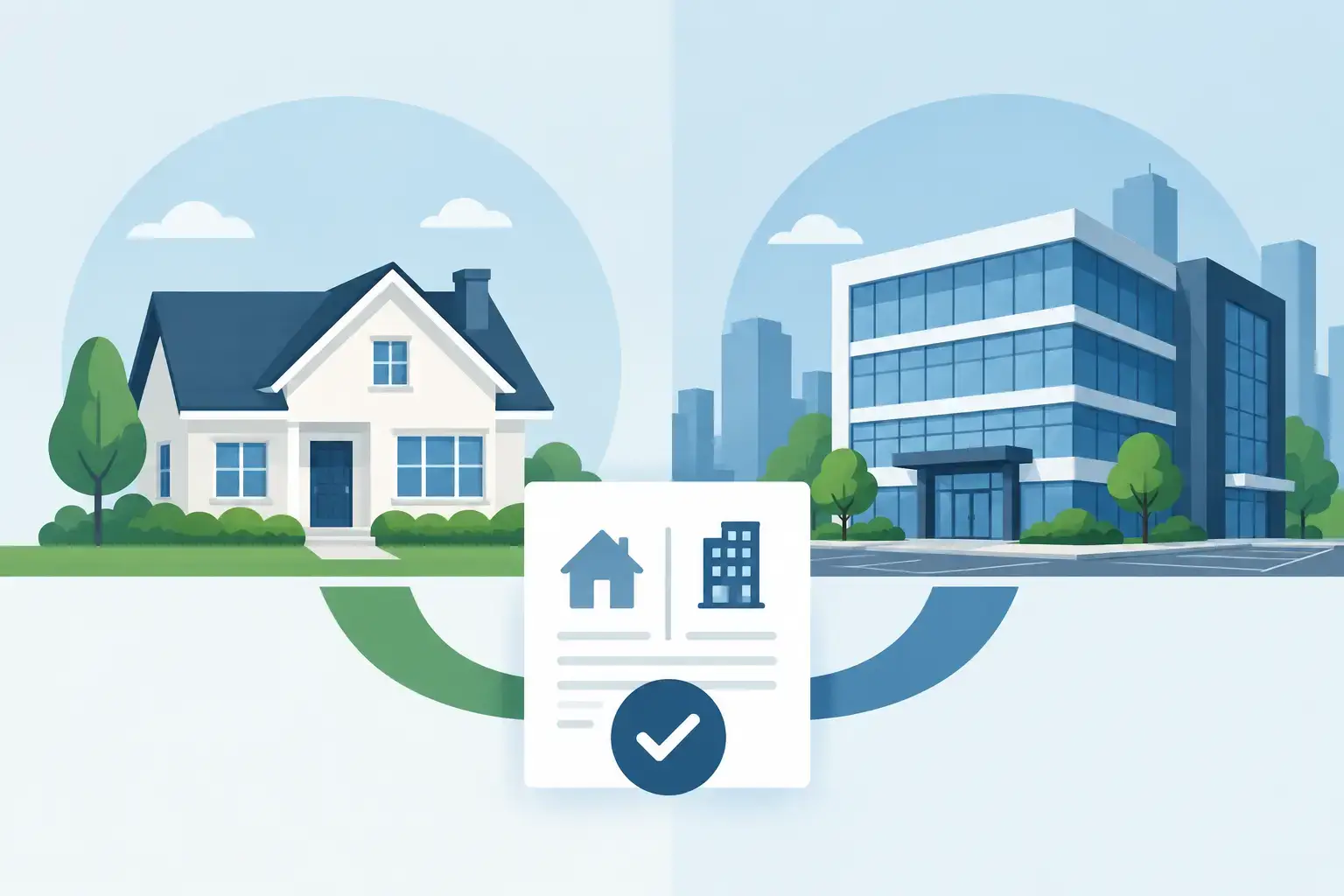
A property can look like a strong opportunity on paper, yet the wrong loan structure can put pressure on cash flow from the first repayment. Understanding residential versus commercial loan terms matters because lenders assess the property, the borrower and the income behind the deal very differently. This is especially relevant for self-employed Australians, company directors and borrowers with non-standard income who may already have found that a mainstream bank’s policy does not reflect their real financial position.
A residential loan is generally designed around a home or residential investment property. A commercial loan is used to buy, refinance or release equity from property used for business purposes, such as an office, warehouse, retail shop, medical suite or industrial site. The dividing line is not always neat. A mixed-use building, a shop with a dwelling above it, or a residential property held within a business structure can require more specialist assessment.
Residential versus commercial loan terms: the core difference
Residential lending is usually more standardised. The lender commonly relies on the borrower’s personal income, living expenses, credit profile and the value of the residential security. Where the applicant is buying an owner-occupied home, the lender is assessing whether the household can sustainably meet repayments.
Commercial lending places more emphasis on the purpose of the property and the strength of the business or rental income connected to it. A lender may consider the tenant, lease terms, business financials, industry, property location and how easily the property could be sold if circumstances changed. If an owner-occupier business is buying premises, the business’s ability to service the debt becomes central.
Neither type of finance is automatically easier. A residential loan may offer sharper pricing and longer repayment periods, but can be harder to obtain if your income does not fit a standard payslip-based model. A commercial loan can be more flexible in structure and documentation, but often comes with lower maximum LVRs, more fees and shorter terms.
Loan terms and repayment periods
Residential home loans in Australia commonly have terms of up to 30 years. Repayments may be principal and interest, or interest-only for an approved period, particularly for investment lending. The longer term can reduce the required monthly repayment, although it may increase the total interest paid over time.
Commercial property loans often have a shorter contracted term, commonly three to 15 years, even where repayments are calculated over a longer amortisation period. For example, a loan may be amortised over 25 years but become due for review or refinance after five years. This can leave a residual balance, sometimes called a balloon, at the end of the initial term.
That structure is not necessarily a problem. It can suit a business owner expecting growth, a planned sale, or a refinance once stronger trading figures are available. But it must be planned for. A borrower should not assume a future refinance will be automatic, particularly if property values, interest rates or business performance have changed.
Fixed, variable and interest-only options
Residential borrowers may have access to variable, fixed or split-rate loans, plus features such as redraw and offset accounts. Availability depends on the lender and product, but these features can be valuable when managing household cash flow or holding savings against a home loan.
Commercial facilities are more likely to be individually structured. Variable rates are common, while fixed-rate options may be available for selected terms. Interest-only repayments can assist a business that needs to preserve working capital, but they do not reduce the principal balance. Some commercial loans also include line-of-credit or overdraft-style facilities alongside the property loan.
The best repayment type depends on what the property needs to achieve. Lower initial repayments can help protect cash flow, while principal reduction builds equity and may improve future borrowing options.
Rates, fees and the true cost of finance
Residential loans often have lower interest rates than commercial loans because residential property is generally viewed as more liquid security and the products are more widely standardised. That does not mean the advertised rate is the only number that matters. Comparison rates, ongoing fees, mortgage insurance where applicable, valuation costs and fixed-rate break costs can all affect the overall cost.
Commercial rates are commonly priced according to risk. A long lease to a financially strong tenant in a well-located industrial property may receive different pricing from a specialised property with a short lease, vacancy risk or a niche buyer market. The borrower’s experience, financial position, credit history and the loan amount can also influence the outcome.
Commercial applications may involve establishment fees, legal fees, valuation fees, annual review fees and early repayment costs. These costs should be assessed alongside the rate, not after the loan has been approved. A lower rate can be less attractive if the facility is too restrictive for your business plans.
LVR: how much can you borrow?
Loan-to-value ratio, or LVR, is the loan amount expressed as a percentage of the property value. With eligible residential purchases, specialist options can reach up to 95% LVR. Higher-LVR lending can help borrowers enter the market sooner, although it usually requires stronger assessment and may involve lender’s mortgage insurance or a risk fee.
Commercial LVRs are usually more conservative. The maximum may depend on the property type, location, lease strength and whether the borrower is purchasing as an investor or for their own business use. A standard commercial property may support a higher LVR than a specialised asset such as a motel, childcare centre, service station or regional hospitality venue.
A lower LVR is not simply a hurdle. More equity can improve pricing, reduce the lender’s risk and give the borrower a buffer if the valuation comes in below the contract price. On the other hand, tying up all available cash in a deposit may leave a business short of funds for fit-out, stock, staff or unexpected costs. The right deposit level is a cash-flow decision as much as a lending decision.
Income evidence and documentation
For a straightforward residential application, lenders often ask for payslips, bank statements, tax returns and notices of assessment. Yet many capable borrowers do not present income this way. A self-employed applicant may retain profit in the business, have recently changed structures, or earn through trusts, companies, commissions or overseas employment.
Specialist residential lenders may consider alternative documentation, including BAS statements, accountant declarations, business bank statements and other evidence of consistent income. The exact documents and maximum LVR will vary by lender. Clear records still matter, particularly where there has been adverse credit, a short employment history or a recent return to self-employment.
Commercial lenders can request company tax returns, financial statements, BAS, management accounts, business bank statements, lease documents and forecasts. For investment property, they will often review rental income, tenant quality, lease expiry dates, outgoings and vacancy assumptions. For owner-occupied premises, they may look closely at the business’s turnover, profitability and capacity to withstand a slower trading period.
If your records are incomplete, it does not always mean the deal cannot proceed. It means the application needs to be matched carefully to lenders that understand the evidence you can provide.
Security, guarantees and personal exposure
Residential finance is usually secured by a mortgage over the home or investment property. If borrowing in personal names, the borrowers are generally responsible for the debt. Where a company or trust is involved, the structure can be more complex.
Commercial lending frequently involves security beyond the property itself. A lender may seek personal guarantees from directors, company guarantees, security over other property or a general security agreement over business assets. This is particularly common when a company or trust is the borrowing entity.
Personal guarantees deserve close attention. They can mean that a director remains personally exposed if the company cannot meet its obligations. The commercial property may sit within a separate entity, but the lender will often still assess the people behind it. Independent legal and financial advice may be appropriate before signing guarantees or security documents.
Credit history can affect the path, not end it
A clean credit file can widen lender choice in both residential and commercial lending. However, a past default, discharged bankruptcy, Part 9 debt agreement, tax debt or missed repayment does not automatically rule out finance. The key questions are what occurred, when it occurred, whether it has been resolved and whether the current position is stable.
For commercial borrowers, lenders may also distinguish between a personal credit issue and a business event caused by a specific disruption. Evidence of repayment conduct since the event, current cash flow and available equity can make a material difference. Trying to hide a credit issue usually creates delays. Explaining it early allows the application to be presented accurately and to lenders whose policies may suit the circumstances.
Choose the facility that supports the next step
The practical question is not whether residential or commercial finance is better. It is whether the proposed loan reflects the security, ownership structure, income source and plan for the property. A residential investment loan may suit a dwelling leased to tenants. A commercial facility may be essential for a warehouse, practice or shop. In mixed-use and unusual-property cases, the lender’s interpretation can be just as important as the property’s label.
Before signing a contract or accepting a refinance offer, examine the repayment method, review date, residual balance, LVR, fees, guarantees and documents required for approval. Finance Me can help borrowers with complex income, credit or property scenarios understand those terms, prepare the right evidence and pursue a lending pathway that supports the next move rather than limiting it.